
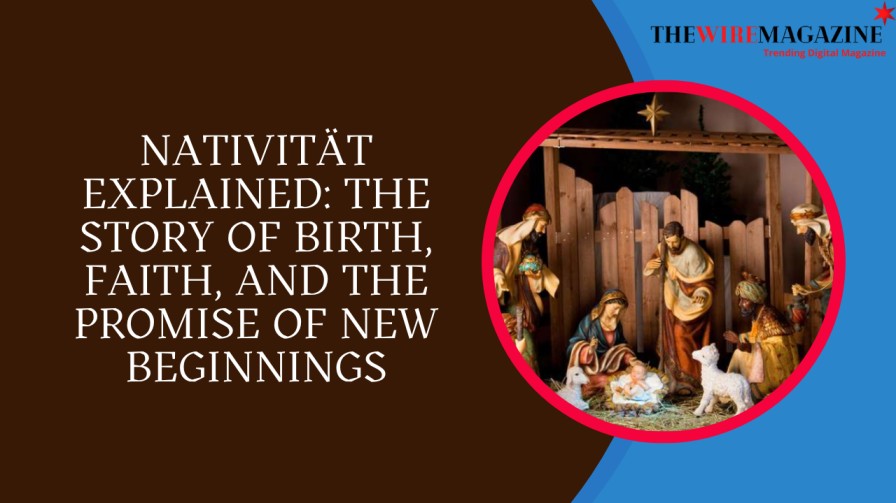
The word Nativität may sound old-fashioned, but its meaning has never lost its relevance. It is based on the Latin Nativität, meaning birth or origin and embodies one of the most significant themes of humanity’s beginnings. In generic German, it may be translated to mean born or a state of natural purity. But in the most popular meaning, Nativität is the nativity of Jesus Christ, a legend that influenced centuries of belief, art and culture.
The spirit of Nativität is still endemic in candlelit churches, traditional paintings, in the most modest of cribs, and in the radiant Christmas markets. It is about new hope, God’s promise, and the unshakable belief that even the smallest life can change the course of the world.
What Does Nativität Mean?
Simply, Nativität translates to the process or condition of birth. But, as with most words of the antique, it came to mean more than it said. Nativität, in Christianity, is the birth of Jesus, the time when, according to the religion, God came into the history of mankind in the person of a baby. This birth was not just a tale; it was a message on renewal, humility, and Godly love.
The word has a life of its own outside religion. The position of the stars and planets on the day of the birth of a person is described in astrology as a Nativität (or natal chart). In biology, German scientists use “nativ” to describe the natural, undenatured state of a protein, its purest and healthiest form
The Birth That Changed History
To Christians, the Nativität is the birthplace of Jesus in Bethlehem more than two thousand years ago. The narrative is not complicated and has a lot of meaning. This is a young woman, Mary, who conceives her son in a stable, and she is surrounded by animals. Shepherds, the fields are announced about the event by angels. Wise men pursue a star shining to give tribute to the newborn. It is like a mix of heaven and earth, a divine message covered with muted shouts of a baby.
How the Concept Evolved Through History
The idea of celebrating the Nativity took root in the 4th century. Early Christians had started to celebrate the birth of Christ on December 25 as a combination of the old winter celebrations with the new theological interpretation. By the Middle Ages, Nativität was a key to European religious life. The churches were decorated on the altar with Bethlehem scenes. The story was repeated through verse and colour by poets and painters.
Such artists as Giotto, Fra Angelico, and Botticelli all created sweet pictures of the Holy Family not to decorate walls, but to teach faith. Their creation was full of wonder and closeness and was the divine personified. With time, each of these cultures introduced its flavour. Living nativity scenes (Presepi viventi) became a community affair in Italy. In Germany, wooden crèches and carved figures appeared in homes. In Latin America, bright fabrics and music filled the story with local joy.
Theological Meaning
Nativität, theologically, means something bigger than the birth of an infant. It symbolises God’s choice to enter the world as one of us. This is the very core of the Christian belief of Incarnation, the unity of both divine and human in Jesus. It is an extreme concept: a deity in the form of vulnerability.
The birth is too full of echoes of prophecy. There is ancient Hebrew literature that talked of an impending Messiah who would bring peace and justice.
Artistic and Cultural Impact
Where Nativität had a meaning, art had a visibility. The nativity has given rise to some of the most stable cultural products of the Western tradition, including medieval hymns such as O Magnum Mysterium and the frescoes of the Renaissance and the Christmas carols of the present day. The story was used to examine the theme of motherhood, tenderness and light by the artists.
It is a story brought back into life every December in the form of music, theatre and film. They hang nativity scenes in their homes, with each character reminding a family of a historic fact: every single character in the narrative, as a shepherd or a king, has a role to play in the divine plan.
Beyond Religion: Nativität in Other Fields
Nativität has a meaning outside the church walls. Astrology is the art of mapping out the heavens at the time of birth to provide a chart of possible personalities. In science, nativ is used to refer to the functional state of biomolecules. Even here, the essence is the same: the idea of purity, origin, and untouched form. Whether spiritual or scientific, Nativität reflects humanity’s fascination with beginnings, the first spark that sets everything in motion.
Modern Relevance
In a world that is moving too fast, Nativität offers a pause, a reminder that renewal often starts small. All births, all new thoughts, all charity are echoes of the spirit of Nativitat. It is about potential and the strength to start afresh.
The nativity is reinterpreted by many contemporary philosophers and artists in social or ecological contexts as a challenge to take care of the planet, to save the weak, and to discover holiness in austerity. Although the story is ancient, it remains relevant to the contemporary desire to have a sense of meaning and peace.
Conclusion
Nativität is not a word; it’s a thread connecting theology, art, science, and everyday life. It is a glorification of the miracle of birth, physical and spiritual. It informs us that humility can produce greatness and that when all is dark, it is possible to bring back hope.
Whether you see it in a painting, hear it in a hymn, or feel it in a newborn’s cry, Nativität reminds you of this: every beginning matters. It’s not just about the first breath of a baby in Bethlehem. It’s about the birth of light, compassion, and renewal, again and again, in every generation.