
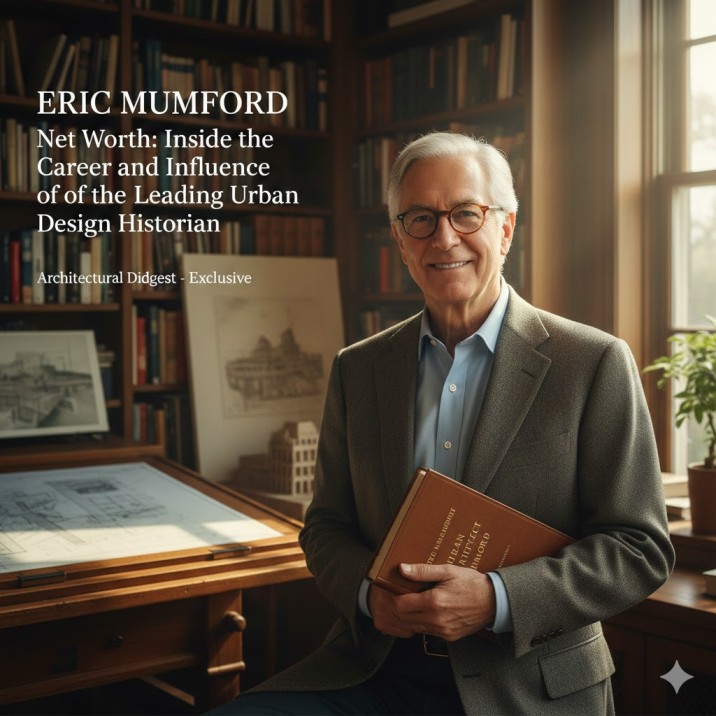
Eric Paul Mumford occupies a rare space in architecture. He connects the design practice, the historical topics and the urban theory with confident elegance. In the course of 30 years, his writing has transformed the way in which academics understand modern cities. Instead of criticising or accusing modernism, he describes it. That clarity defines his career.
Who Is Eric Paul Mumford?
Eric Paul Mumford is an educator, historian and architect. He serves as the Rebecca and John Voyles Professor of Architecture at Washington University in St. Louis. He is a scholar on the history of modern architecture and urban design. He is most known for his authoritative study of CIAM. Mumford is a licensed architect, too. His historical writing is based on that professional grounding. He takes theory as something that influences the real streets and lives. This equilibrium makes his work peculiar in terms of credibility.
Educational Background and Intellectual Formation
Mumford’s academic path reflects both breadth and focus. In 1980, he got his undergraduate degree in History from Harvard College. That education made him more alert to political and social situationalism. He attended the Architectural Association in London in 1981. There, he came across European arguments about the new architecture in reality.
These ideas stayed with him. He then earned a Master of Architecture from MIT in 1983. His critical thinking was influenced by MIT, with its focus on modern design and technology. In 1996, he obtained a doctoral degree from Princeton University. In his PhD, he started the CIAM research, which characterised his career.
Academic Career and Teaching
In the year 1994, Mumford became part of Washington University in St. Louis. He has stayed there since then. Those continuities enabled him to create a rich research and teaching legacy. His work includes the history, theory, and urban design of architecture. He is also involved in graduate supervision and reviews of studios.
His capability to relate history to current debates is an aspect that is frequently observed by the students. Outside Washington University, he has been a visiting professor at Harvard and Columbia. He also chaired the Harvard Graduate School of Design Visiting Committee. These positions demonstrate his position in the field of architectural teaching.
Major Publications and Scholarly Impact
The books of Mumford are popular in universities. Architectural research is also heavily referenced to them. His work, The CIAM Discourse on Urbanism, 1928–1960, appeared in 2000. It was the first complete history of the International Congresses of Modern Architecture. The concept of CIAM influenced the planning of the twentieth century more than any other organisation. Mumford described how its concepts developed, broke, and finally dissolved.
His book, Defining Urban Design (2009), followed the development of the discipline of Urban design. The book received significant academic attention. His textbook Designing the Modern City (2018) widened his influence.
It surveys urbanism from 1850 to the present. The book is a rare combination of design, politics, and social change. In 2024, Mumford released Design Agendas. The book was in a show on contemporary architecture in St. Louis. It linked the history of design to race, policy and urban renewal.
Research Themes and Ideas
The work by Mumford has a number of common concerns. To begin with, he demands historical context. He shows why architects made certain choices at specific moments. Second, he researches the formation of disciplines. The form of urban design was not as complete. It came into existence in institutions, schools and debates.
Third, he does not take modernism lightly. He knows its idealism and does not overlook its failures. This balanced view sets him apart from critics and defenders alike. His studies cover equity and housing more recently. Such projects as the Edges of Privacy project investigate the concept of collective living. These researchers associate the experiments of the past with the current requirements.
Professional Roles and Honours
Mumford is not only a publishing leader. He is a Director of the Society of Architectural Historians. This position puts him in the centre of the field. He is also the advisor to the Canadian Institute of Advanced Research. His global research is respectful of his scholarship. There are awards such as a Getty Research Institute residency and a Fulbright Specialist Award. These awards are depth-relevant and relevance-based.
Eric Mumford Net Worth and Professional Earnings
There is little accessible data regarding the eric mumford net worth. That is common for academics. Eric Mumford’s estimated net worth could be around $5 million. He earns money through various sources of his occupation. These consist of a professorship endowment, royalty payments on books and speech fees. There is also the contribution made by exhibitions and consulting. His pay is competitive as he is a highly ranked professor in a large research university.
University press revenues are small but consistent. Residencies such as the Getty usually also have support and stipends. Eric Mumford net worth should not be speculated on. His worth is more intellectual capital than monetary accumulation. Nevertheless, his decades-long career indicates financial security in academic standards.
Conclusion
Eric Paul Mumford has influenced the perception of urbanism in the contemporary world. His writing defines concepts that shape cities to date. He is a careful writer, a profound teacher, and an upright leader. Instead of providing judgments of convenience, he gives insights. That approach makes his scholarship endure. Whether one studies history, planning, or design, his influence is hard to escape. Arguments regarding the eric mumford net worth can be discussed on the internet. Yet his lasting wealth lies in ideas, students, and cities better understood.